 NURL registrynurl-lang.org →
owner @Hindurable
[dependencies]
objdet = "^0.3.3"
0.3.3 · 2026-07-26 · @Hindurable · files · api0.3.2 · 2026-07-20 · @Hindurable · files · api0.3.1 · 2026-07-07 · @Hindurable · files · api0.3.0 · 2026-07-05 · @Hindurable · files · api0.2.1 · 2026-07-01 · @Hindurable · files · api0.2.0 · 2026-06-30 · @Hindurable · files · api0.1.0 · 2026-06-30 · @Hindurable · files · apiDetect objects in an image or video feed using a tiny-YOLOv2-style ONNX model — written entirely in NURL. The image is decoded natively through packages/image (PNG, baseline+progressive JPEG, PPM — no ImageMagick), the network runs on the GPU through packages/onnx (every layer a CUDA-C kernel compiled at runtime via NVRTC — no external inference engine), and the YOLO grid is decoded into labelled boxes with non-max suppression.
Verified against onnxruntime on the ONNX model-zoo tinyyolov2-8.onnx: identical class scores and boxes.
$ objdet tinyyolov2-8.onnx dog.jpg out.png
device: NVIDIA GeForce RTX 4090
image 416x416
detections:
  dog 0.764437  box[x=55 y=161 w=129 h=220]
  car 0.763744  box[x=240 y=66 w=133 h=68]
wrote out.png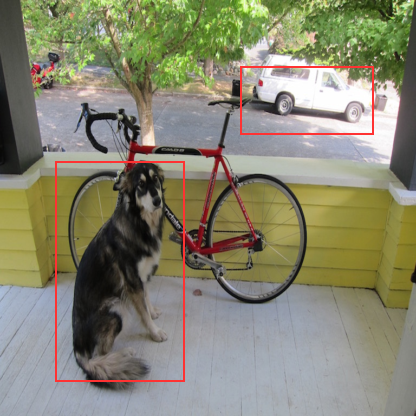
objdet <model.onnx> <image.{png,jpg,ppm}> [out.{png,jpg,ppm}] # single image
objdet <model.onnx> --video <in_dir> <out_dir> <count>        # frame sequence
Stills are decoded and encoded natively (PNG / JPEG / PPM, by extension) — feed it a photo straight from a camera. in_dir/out_dir hold frame00000.ppm, frame00001.ppm, … The video mode reuses one GPU engine (kernels compiled once) across all frames; use ffmpeg for the container:
objdet tinyyolov2-8.onnx photo.jpg out.png

ffmpeg -i clip.mp4 -vf fps=10 in/frame%05d.ppm     # video → frames
objdet tinyyolov2-8.onnx --video in out $(ls in | wc -l)
ffmpeg -framerate 10 -i out/frame%05d.ppm out.mp4  # frames → video
Non-416×416 images are bilinear-resized to the model input; boxes are reported in the original image's pixel coordinates.
The model is not bundled (≈63 MB). Fetch the ONNX model-zoo detector:
curl -L -o tinyyolov2-8.onnx \
  https://github.com/onnx/models/raw/main/validated/vision/object_detection_segmentation/tiny-yolov2/model/tinyyolov2-8.onnx
Any ONNX model with the same shape works: NCHW float input, a Conv/BatchNormalization/LeakyRelu/MaxPool backbone, and a [1, 125, 13, 13] YOLOv2/VOC grid output (5 anchors × (5 + 20 classes)).
image.ppm ─image.nu─▶ 416×416 NCHW ─onnx(GPU)─▶ [1,125,13,13] grid ─detect.nu─▶ boxes ─▶ annotated.ppm
           load+resize             tiny-yolov2                      decode + NMS      draw
src/image.nu — PPM (P6) read/write, bilinear resize, box drawing,NCHW float packing. Pure NURL over a byte Vec.
src/detect.nu — YOLOv2 grid decode (per cell × anchor: sigmoid box,exp size, softmax class), the 20 VOC class names, and non-max suppression. CPU — the grid is small (13×13×5).
src/main.nu — the CLI: load model + image, run on the GPU viapackages/onnx, decode, print, draw, write.
The network itself runs entirely on the GPU; only the lightweight decode runs on the CPU. The single native dependency (CUDA driver + NVRTC) lives in the gpu package, so a GPU-less host is unaffected.
tests/detect_test.nu covers the model-free logic (PPM round-trip, resize, NCHW packing, grid decode on a synthetic grid, NMS, class names) and runs without a GPU. The end-to-end GPU path is the demo above. tests/data/ holds the reference generator (gen_ref.py, needs onnx+onnxruntime).
libcuda.so) + NVRTC (libnvrtc.so) — via onnx → gpu.ffmpeg/ImageMagick for other formats and video.v0.1.0 is a proof-of-concept targeting tiny-yolov2 (VOC, 20 classes). The op set it relies on lives in packages/onnx and is built to extend toward YOLOv3/v5/v8-class detectors (more ops, multi-scale heads).